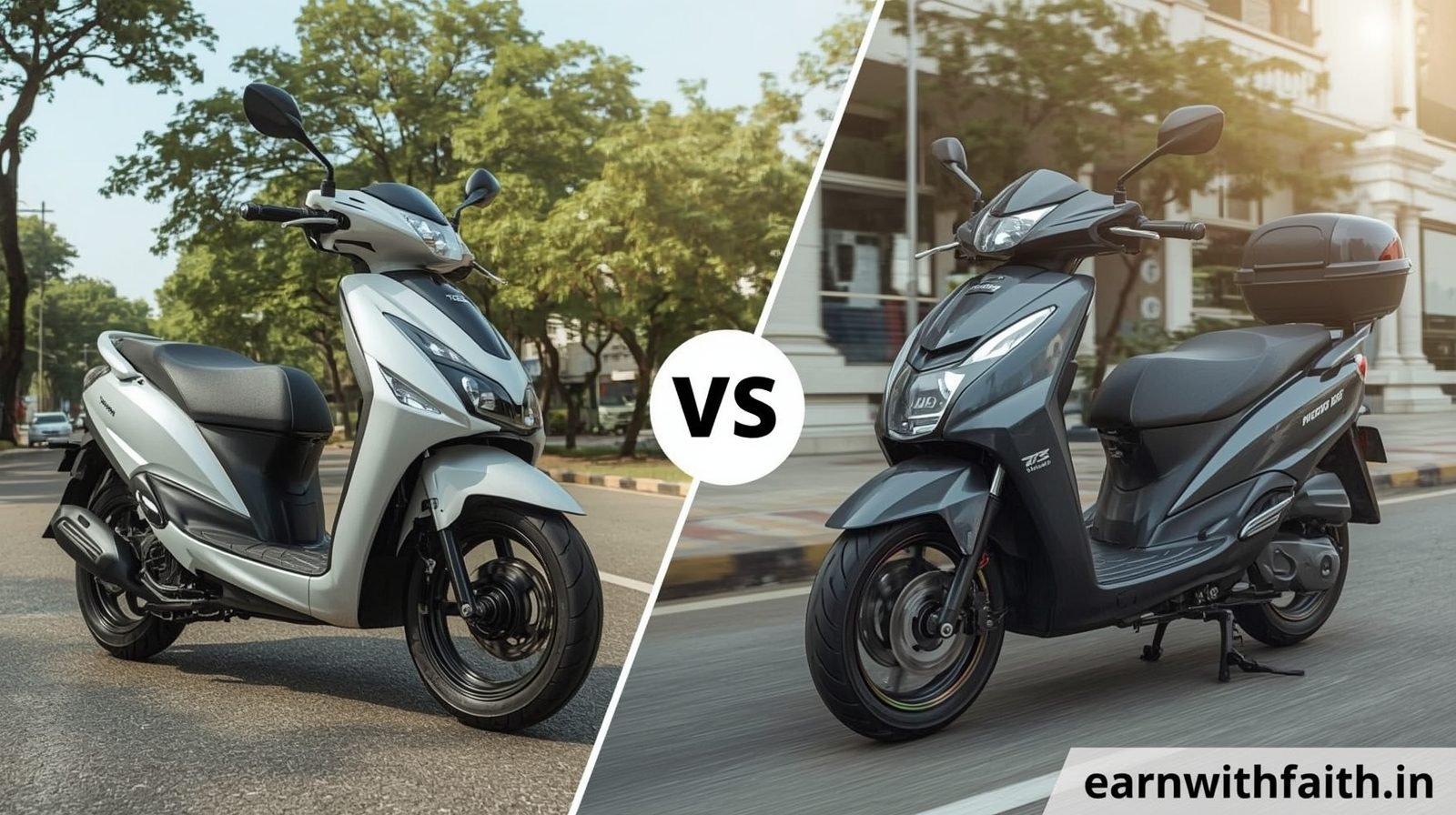
Deciding between an electric vs petrol scooter? Our ultimate guide breaks down the true cost of ownership, performance, and long-term benefits to help you choose your perfect ride. Find out which is better for you!
It’s 8:30 AM, and Arjun is staring at the fuel gauge on his old petrol scooter. A sinking feeling 🤯. He knows what comes next: the dreaded trip to the gas station, the rising prices flickering on the digital board like an ever-present taunt. He can almost hear the familiar grumbling of his scooter’s engine, a sound he once associated with freedom but now links to noisy traffic, expensive maintenance, and that faint, acrid smell of exhaust fumes. He sighs, pulling on his helmet, feeling a mixture of frustration and resignation.
Then, a whisper of a sound glides past him. It’s his friend, Maya, on her new electric scooter. There’s no roar, just a sleek, almost silent whoosh as she effortlessly maneuvers through the morning rush. She gives him a cheerful wave, and he can’t help but notice the relaxed smile on her face. No fuss, no fumes, no frantic search for a pump. Just pure, unadulterated calm.
In that fleeting moment, a question that has been nagging at him for months crystallizes: Is it time to switch? Is this the crossroads where his noisy, expensive reality meets a clean, quiet, and more sustainable future? 🤔
This isn’t just Arjun’s story. It’s the silent dilemma playing out in millions of minds across the world. The choice between an electric vs petrol scooter is no longer a niche conversation—it’s a pivotal decision about our wallets, our convenience, and our planet. This ultimate guide is here to help you navigate that very crossroads. We’ll go beyond the spec sheets and dive deep into the real-world performance, long-term costs, and human experiences that define this monumental choice.
The Great Commute Debate: A Head-to-Head Showdown
For decades, the petrol scooter was the undisputed king of the urban jungle. A twist of the throttle, a splash of fuel, and you were off. Simple. Reliable. But a new contender has emerged, one that promises a new kind of freedom. To truly understand the debate, we need to compare them not just on paper, but in the context of your daily life.
The Engine vs. The Battery: Performance & Power
At its core, the difference between these two rides comes down to their power source. One harnesses the explosive power of gasoline, the other, the quiet potential of electricity. But what does that mean for the rider?
Acceleration & Top Speed
Petrol scooters typically deliver a linear, steady build-up of power. You feel the engine revving as you accelerate. In contrast, electric scooters are known for their instant torque. That means as soon as you twist the throttle, the power is delivered directly to the wheel. It’s an immediate, satisfying surge that makes zipping away from traffic lights or navigating congested lanes feel effortless.
- Petrol Scooter: A familiar, steady climb to top speed. Good for sustained high speeds on open roads.
- Electric Scooter: Instant, silent acceleration. Perfect for the stop-and-go nature of city commuting.
The Silent Revolution
One of the most profound differences is the sound—or lack thereof. A petrol scooter’s engine is a constant soundtrack to your ride. For some, it’s a comfort; for others, a source of stress and noise pollution. The benefits of an electric scooter include a ride that is almost completely silent. Imagine gliding through a quiet residential street in the early morning or arriving home late at night without waking the neighborhood. It’s a small change with a huge impact on your daily experience.
The Range Reality Check: Is Range Anxiety a Real Problem?
This is perhaps the biggest concern for anyone considering an electric scooter. The fear that your battery will run out mid-journey, leaving you stranded. While a petrol scooter can be refueled in minutes almost anywhere, the charging infrastructure for EVs is still evolving.
However, the reality is far from the anxious scenarios many imagine. Most modern best electric scooters offer a real-world range of 80-120 km on a single charge—more than enough for the average daily commute. You simply plug it in overnight, like your phone, and wake up to a full “tank.”
Here’s a quick, easy-to-digest comparison on a typical day’s commute:
| Feature | Petrol Scooter | Electric Scooter |
| Daily Ritual | Trip to the gas station, waiting in line, filling up. | Plug in at home overnight. |
| Fuel/Charging Time | ~5-10 minutes | ~4-6 hours (overnight) |
| Avg. Daily Range | 200-300 km (Full Tank) | 80-120 km (Full Charge) |
| Flexibility | High. Gas stations are everywhere. | Limited. Relies on charging points or home charging. |
Export to Sheets
The Wallet’s Verdict: Cost of Ownership Decoded 📊
This is where the debate gets truly interesting. The price of an electric scooter is often higher upfront, leading many to believe they are the more expensive option. But that’s only part of the story. The long-term savings can be a game-changer for your personal finances.
Purchase Price & Upfront Investment
Yes, you will likely pay a bit more for a comparable electric model. However, government subsidies and tax incentives in many regions are designed to close this gap and encourage adoption. This is a critical factor to research, as these incentives can significantly lower your initial outlay.
Fuel vs. Charging: A Daily Expense Battle
This is the number one area of savings. Let’s crunch some numbers with a hypothetical example:
- Petrol Scooter: A scooter giving 50 km/L, with petrol at ₹100/L. Cost per km: ₹2.00.
- Electric Scooter: A scooter consuming 3 units of electricity for a full charge (75 km range), with electricity at ₹8/unit. Cost per km: ₹0.32.
The math is staggering. Over a year, a daily 20 km commute would cost ₹14,600 on petrol vs. just ₹2,336 for an electric scooter. That’s a saving of over ₹12,000 annually just on “fuel.” 💡
The Mechanics of Savings: Maintenance & Repairs
This is the hidden gem of electric scooter benefits. A petrol engine is a complex machine with dozens of moving parts that need regular attention.
- ➡️ Electric Scooters: The power unit is a sealed, motor hub with very few moving parts. There’s no engine oil to change, no spark plugs to replace, no air or oil filters to clean, and no clutch to adjust. The primary maintenance is checking tire pressure and brake pads.
- ⬅️ Petrol Scooters: Requires regular oil changes, filter replacements, spark plug checks, valve adjustments, and more. A scooter running for 10 years will have spent a fortune on these costs.
This is a key reason why the petrol scooter maintenance cost vs electric is a deciding factor for many riders. The relief of avoiding a mechanic’s hefty bill is a powerful motivator.
The Battery Question: A Long-Term Investment
The electric scooter battery replacement cost is a valid concern. The battery pack is the most expensive component of an EV. However, modern lithium-ion batteries are designed to last for a long time. Most manufacturers offer a warranty of 3-5 years, and the battery itself is expected to retain at least 70-80% of its capacity for 6-8 years or even longer. While a replacement is a significant expense, it’s a one-time cost that is often offset by the accumulated savings on fuel and maintenance over a period of 5-7 years.
The Eco-Conscious Commuter: Your Carbon Footprint
For many, the decision is not just financial—it’s a moral one. The air we breathe is a shared resource, and our choices on the road have a direct impact.
The Exhaust Pipe vs. Zero Emissions
This one is simple. A petrol scooter emits pollutants like Carbon Monoxide (CO), Hydrocarbons (HC), and Nitrogen Oxides (NOx), all of which contribute to smog and respiratory issues. An electric scooter, on the other hand, produces zero tailpipe emissions. Period. It’s a clean machine that directly improves the air quality in our cities.
The Battery’s Dilemma: Manufacturing & Disposal
While EVs have zero tailpipe emissions, their manufacturing process, particularly the batteries, does have an environmental cost. The mining of materials like lithium and cobalt, and the energy consumed during production, are legitimate concerns. However, this is a rapidly evolving field. Manufacturers are making huge strides in battery recycling, and a growing number of companies are using renewable energy sources for production. Over the lifetime of the vehicle, an electric scooter’s total carbon footprint is still significantly lower than a petrol scooter’s.
Everyday Life & Convenience: The Human Factor
The scooter isn’t just a machine; it’s a part of your daily routine. So, how do these two compare when it comes to the lived experience?
Charging Infrastructure: Myth vs. Reality
A common fear is that you’ll be stranded in a desolate urban landscape with no way to charge. In reality, the most crucial charging point is your own home. For the vast majority of commuters, home charging is all they will ever need. The need for public charging is for long-distance travel, a use case less common for scooters. However, in major cities, the number of public charging stations, and even battery-swapping networks, is growing exponentially.
Reliability & Durability
The simplicity of an electric scooter’s motor makes it incredibly reliable. With fewer moving parts, there are fewer things that can go wrong. Petrol engines, with their complex components, are more susceptible to wear and tear. While a petrol scooter can be robust, an electric one’s durability, especially in the long run, is often superior.
Re-sale Value & Market Trends
The re-sale market for petrol scooters is well-established. For EVs, it’s still maturing. However, with the government’s push for a green transition and the rising popularity of EVs, the best electric scooter models are expected to hold their value well as demand continues to rise.
Debunking Myths & Answering Your Toughest Questions
The journey to an electric future is fraught with misinformation. Let’s clear the air and address the most common concerns.
- Myth #1: “Electric scooters are slow and boring.” ❌ Reality: False. With instant torque, many best electric scooters offer zippy acceleration that feels exhilarating in city traffic. While top speeds may be limited for safety and efficiency, they are more than adequate for urban commuting.
- Myth #2: “The battery will die in a year.” ❌ Reality: Highly unlikely. Most batteries are rated for thousands of charge cycles. With proper care, they are designed to last for many years. It’s a key investment, but a durable one.
- Myth #3: “I can’t find a place to charge it.” ❌ Reality: For most, the “place to charge” is your garage, carport, or even a wall socket in your building’s parking lot. The need for a public charging station is an exception, not the rule, for scooter users.
The Future is Electric: What’s Next?
The shift from fossil fuels to electricity is not a temporary trend; it’s the direction of a global movement. With innovations in battery technology promising even longer ranges and faster charging, the future of the scooter is undoubtedly electric. Governments are actively pushing for this transition with policies and incentives, and the market is responding with a wave of exciting new models. Your choice today is not just about a vehicle; it’s about aligning yourself with a greener, smarter, and more efficient future.
Conclusion: Your Personal Commute Compass
The debate between electric vs petrol scooters is complex, touching on finances, convenience, and our values. There’s no single “right” answer for everyone. The petrol scooter remains a dependable workhorse, especially for those who need to cover long distances without a planned charging stop. But for the vast majority of urban commuters—those fed up with rising fuel prices, constant maintenance, and city pollution—the benefits of an electric scooter are simply too compelling to ignore.
It’s a journey of quiet confidence, significant savings, and a clear conscience. It’s the moment when you look back at the expense and noise of the past and glide forward into a future that’s cleaner, simpler, and more efficient.
Ready to take the next step towards a smarter, more sustainable ride? 🚀 Explore our hand-picked selection of the best electric scooters and find the perfect match for your lifestyle. Your journey towards a better commute starts now! ✨